
GST 2.0 may cushion consumers against US tariffs, but like the 2019 corporate tax cut, it risks being another tactical fix rather than a structural growth strategy, expects Debashis Basu.

India should convert the Trump threat to an India opportunity, re-embracing a more liberal trade regime as a way of reviving manufacturing output and exports.

India's service sector activity accelerated slightly in April largely driven by a quicker increase in new order inflows, which also underpinned a faster expansion in employment, a monthly survey said on Tuesday. The seasonally adjusted HSBC India Services PMI Business Activity Index reached 58.7 in April, up from 58.5 in March, indicating a sharp and stronger expansion in service sector output.

We have entered a new era in human history, asserts Aakar Patel.

Manufacturing activities in India gained momentum in August as new orders and output increased at the quickest rates in nearly three years, according to a survey released on Friday. The seasonally adjusted S&P Global India Manufacturing Purchasing Managers' Index (PMI) rose to 58.6 in August from 57.7 in July. Pollyanna De Lima, Economics Associate Director at S&P Global Market Intelligence, said the PMI results for India painted a vibrant picture of the nation's manufacturing landscape in August.

Reliance Industries has built four high-powered growth engines of retail, digital services, media and entertainment, and new energy to propel the conglomerate's next phase of expansion, Chairman Mukesh Ambani said. Parallelly, Reliance is reshaping itself into a new-age deep-tech enterprise, he said in a message to shareholders in the firm's latest annual report.

Indian economy is on an upswing with industrial production posting its highest growth in a decade at 12.4 per cent

India's industrial production growth decelerated to a six-month low of 2.9 per cent in February 2025, mainly due to poor performance of the manufacturing, mining and power sectors, according to official data released on Friday. The government also revised upward the industrial growth figure to 5.2 per cent for January 2025 from the provisional estimate of 5 per cent released in March.

'Government officials use Gmail and ordinary phones without basic security consciousness.' 'Interoperability, especially in joint exercises with countries like the US, worries me.' 'It often means we open our systems to them, but they don't reciprocate.' 'They could have kill switches in their systems and might even be able to affect ours.'


India may have to lean more on West Asian nations for supplies of liquefied petroleum gas (LPG), a cooking fuel, in the coming years after Indian state-run refiners drew up big plans to diversify into producing more profitable petrochemicals. This shift leads to reduced LPG output, Indian refining executives said. The mantra for state-run oil companies, from Indian Oil Corporation (IndianOil) to liquefied natural gas (LNG) importer Petronet LNG, which are looking to diversify their businesses from lower-margin fuels, has been value-added petrochemicals.

The Supreme Court has criticized the selective publication of a preliminary report on the Air India crash, calling it 'unfortunate and irresponsible'. The court raised concerns about privacy, dignity of victims' families, and the potential for biased narratives.

Union telecom minister Jyotiraditya Scindia on Tuesday said investment in India at present makes economic sense for every original equipment manufacturer, as he cited the example of US smart devices major Apple's decision to source majority of the iPhones sold in the US from the country. While speaking at the Bharat Telecom event, Scindia said the investment in India at present is not just an act of goodwill alone but it makes economic sense for every OEM (original equipment manufacturer).

From the Sensex pack, Bajaj Finserv, Larsen & Toubro, Bajaj Finance, HDFC Bank, Bharat Electronics and Kotak Mahindra Bank were among the major laggards. However, Tata Steel, Asian Paints, UltraTech Cement, and Trent were the biggest gainers.

Manufacturing sector activities in India moderated in June from a 31-month high in May, but output remained in the growth territory, as new work orders expanded sharply amid favourable demand conditions, a monthly survey said on Monday. The seasonally adjusted S&P Global India Manufacturing Purchasing Managers' Index (PMI) fell from 58.7 in May to 57.8 in June. Despite the fall, the headline figure pointed to a considerable improvement in operating conditions, the survey said, adding that the demand strength positively impacted several other measures such as sales, production, stock building and employment.

India's manufacturing sector continued with its robust performance in November, mainly on the back of substantial easing in price pressures and strengthening demand from clients, a monthly survey said on Friday. The strong performance of the manufacturing sector is expected to continue in 2024 as well. The seasonally adjusted S&P Global India Manufacturing Purchasing Managers' Index (PMI) rose to 56 last month from the eight-month low level of 55.5 recorded in October.

Manufacturing sector, which constitutes over 77 per cent of the index, showed a decline of 0.4 per cent in June as compared to a growth of 7.5 per cent in the same month last year.

Manufacturing activities in India fell to a five-month low in September as new orders rose at a softer pace, which tempered production growth, a monthly survey said on Tuesday. The seasonally adjusted S&P Global India Manufacturing Purchasing Managers' Index (PMI) fell to 57.5 in September, down from 58.6 in August -- the lowest in five months. The September PMI data pointed to an improvement in overall operating conditions for the 27th straight month.

India's industrial production growth slowed to 3.8 per cent in January, while the February retail inflation at 5.09 per cent remained within the Reserve Bank's comfort zone for the sixth straight month, according to the latest government data. Growth in factory output, based on the Index of Industrial Production (IIP), slowed to 3.8 per cent in January 2024, mainly due to poor performance of manufacturing, mining and power sectors, according to the data released by the Ministry of Statistics & Programme Implementation.
The seasonally adjusted S&P Global India Manufacturing Purchasing Managers' Index (PMI) slipped from 57.5 in September to 55.5 in October, the slowest rate of expansion since February. The October PMI data pointed to an improvement in overall operating conditions for the 28th straight month.

Manufacturing's share in the profit pool of companies had declined before the pandemic.
US President Donald Trump on Friday again sought to pressurise Apple on its decision to increase production of its iPhone in India. Trump said that Apple will have to pay a 25 per cent import tariffs if its mobile handsets sold in US are not produced in the boundaries of the country.

India's services sector activity eased slightly in March, weighed down by a marginal slowdown in sales amid softer demand conditions and easing inflationary pressures, a monthly survey said on Friday. The seasonally adjusted HSBC India Services PMI Business Activity Index fell from February's reading of 59.0 to 58.5 in March, but remained above its long-run average of 54.2.

In twin blows to Indian economic revival, higher food prices drove retail inflation to a five-month high of 7.4 per cent while factory output fell for the first time in 18 months. The second consecutive month of rise in consumer price index (CPI)-based inflation will add to the pressure on the Reserve Bank of India (RBI) to again raise interest rates to tame high prices. Inflation has been above the targeted zone for the ninth month in a row and as per statute, the RBI will now have to explain to the government in writing why it failed to keep prices below 6 per cent.

US President Donald Trump on Thursday said he has asked Apple CEO Tim Cook to stop producing iPhones in India, and rather make them in the US.
India's industrial production growth rose to a five-month high of 5.7 per cent in July, mainly due to good showing by the manufacturing, mining and power sectors, according to the official data released on Tuesday. The factory output growth measured in terms of the Index of Industrial Production (IIP) stood at 2.2 per cent in July 2022. The previous high was recorded at six per cent growth in February 2023. Thereafter, the growth rate declined to 1.9 per cent in March 2023 before rising to 4.6 per cent in April and further to 5.3 per cent in May.

Wholesale price inflation dropped to 0.85 per cent in April as prices of food articles, manufactured products, and fuel eased, government data showed on Wednesday. WPI-based inflation was 2.05 per cent in March. It was 1.19 per cent in April last year.
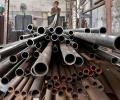
India's leading steel companies hope the Modi 3.0 Budget will continue the massive capital expenditure currently underway, focusing on infrastructure development, manufacturing, and fair trade. The infrastructure segment is the largest steel user, and the government's focus has fuelled steel consumption even as international markets have underperformed. According to provisional statistics, steel consumption grew 13.6 per cent in FY24, reaching 136 million tonnes (mt), according to a CRISIL report.
India's industrial production growth declined to a three-month low of 3.7 per cent in June mainly due to poor showing by the manufacturing sector, according to the official data released on Friday. The factory output growth measured in terms of the Index of Industrial Production (IIP) stood at 12.6 per cent in June 2022 on account of a lower base effect. The previous low of IIP was at 1.9 per cent in March 2023.

Simplifying GST rates, removing exemptions, easing disputes, and speeding up refunds can boost investment in India and offer the best reply to Trump's tariffs, observes V S Krishnan, former member, Central Board of Indirect Taxes and Customs.

A host of macroeconomic data announcements, the last batch of September quarter earnings, global trends, and trading activity of foreign investors will be the major driving factors for the equity market this week, according to analysts. Equity markets would remain closed on Friday for Guru Nanak Jayanti. "India is set to release CPI and IIP data on November 12, with WPI data expected on November 14.

The main factors contributing to the above-50.0 PMI reading were growth of both new orders and output as market conditions returned to normal and led to subsequent improvement in demand.

India's services sector activity witnessed a sharp uptick in February boosted by improving domestic and international demand, which resulted in a quicker expansion in output and a substantial increase in employment, a monthly survey said on Wednesday. The seasonally adjusted HSBC India Services PMI Business Activity Index rose from January's 26-month low of 56.5 to 59.0 in February, indicating a sharp rate of expansion.

Tata Steel's consolidated net profit more than doubled to Rs 2,007.36 crore during the June quarter, on account of "increase in net steel realisations and the planned cost-takeouts" across geographies. The Tata Group entity had posted a net profit of Rs 918.57 crore in the year-ago period.
The growth momentum in India's manufacturing sector was maintained in February, with new orders and output increasing at similar rates to January, according to a monthly survey. The seasonally adjusted S&P Global India Manufacturing Purchasing Managers' Index (PMI) was at 55.3 in February, little-changed from 55.4 in January. The February PMI data pointed to an improvement in overall operating conditions for the 20th straight month. In PMI parlance, a print above 50 means expansion while a score below 50 indicates contraction.

Manufacturing activities in India eased marginally in September but remained in good shape amid companies hiring more workers and cooling price pressures, according to a monthly survey released on Monday. The seasonally adjusted S&P Global India Manufacturing Purchasing Managers' Index (PMI) indicated a strong improvement in the health of the Indian manufacturing industry, as companies stepped up production in tandem with a sustained increase in new work intakes. The PMI at 55.1 in September continued to be in expansion mode for the 15th consecutive month but was slightly lower than 56.2 recorded in August.

Most of the economic activity in the country had come to a standstill after the government imposed a 21-day nationwide lockdown beginning March 25 to check the spread of coronavirus.

India's services sector growth touched a four-month high in December, supported by new business inflows on strong demand conditions and easing inflationary pressures, a monthly survey said on Monday. The seasonally adjusted HSBC India Services Business Activity Index, rose from 58.4 in November to 59.3 in December, highlighting the strongest rate of expansion in four months.
Manufacturing sector activities in India moderated for the second straight month in July as rates of expansion in output and new orders eased slightly, a monthly survey said on Tuesday. The seasonally adjusted S&P Global India Manufacturing Purchasing Managers' Index (PMI) eased to 57.7 in July from 57.8 in June. Despite the fall, the Indian manufacturing sector maintained strong growth momentum at the start of the third quarter amid ongoing buoyant demand, the survey said.

It's a sign that the economy may have turned a corner that strengthens the RBI's case against a rate cut.
